Education is the strongest pillar of a child’s future. Schools these days are not just about books and exams. They are about gearing children up for life. Parents across the globe desire their children to have knowledge, skills, and values. The aim is to enable them to sparkle in the world of tomorrow. Here’s where CBSE education steps in.
Indians trust the Central Board of Secondary Education (CBSE) in education. For decades, it has led lakhs of students all over the country. But education is changing rapidly. The future will be very different from the past. New approaches, technologies, and ideas are revolutionising children’s education.
So, what does the future look like for CBSE education? What are the trends and innovations that will make their way into schools? And most crucially, how will these CBSE-affiliated English-medium schools influence your child’s development and achievement? Let us find out.
What is CBSE Education?
CBSE is an acronym for the Central Board of Secondary Education. CBSE is one of India’s largest and most well-known education boards. It is recognised for its well-balanced curriculum covering academics, co-curricular activities, and values.
The CBSE system adopts a kid-friendly philosophy. Rather than mere memorisation, students are asked to grasp concepts. The syllabus makes children ready for national-level tests such as NEET, JEE, and UPSC. On the other hand, it also focuses on languages, sports, arts, and social skills.
Owing to this balance, parents rely on CBSE-affiliated schools in Howrah for providing kids with a solid foundation in life.
Why CBSE Education is Important for Our Children
A well-educated system does not merely teach. It instils character, confidence, and creativity. CBSE schools make children future-ready in various ways:
- They emphasise conceptual learning rather than mugging up.
- They have continuous assessments so that children do not feel stressed only during exam periods.
- They encourage sports, arts, and co-curricular activities to develop all-around growth.
- They make children study for competitive exams and higher studies.
- They also encompass values of morality and life skills. The aim is to make the students responsible citizens.
With these capabilities, CBSE schools in Howrah, West Bengal, serve as launchpads for future-ready kids.
The Future of CBSE Education: Upcoming Trends
Education never remains static. The CBSE board has been evolving to keep up with the needs of the contemporary world. The following trends and innovations will guide the future of CBSE.
1. Technology-Enabled Learning
Technology has extended itself into every nook and cranny of our lives. Education cannot remain left behind. CBSE schools are now adopting:
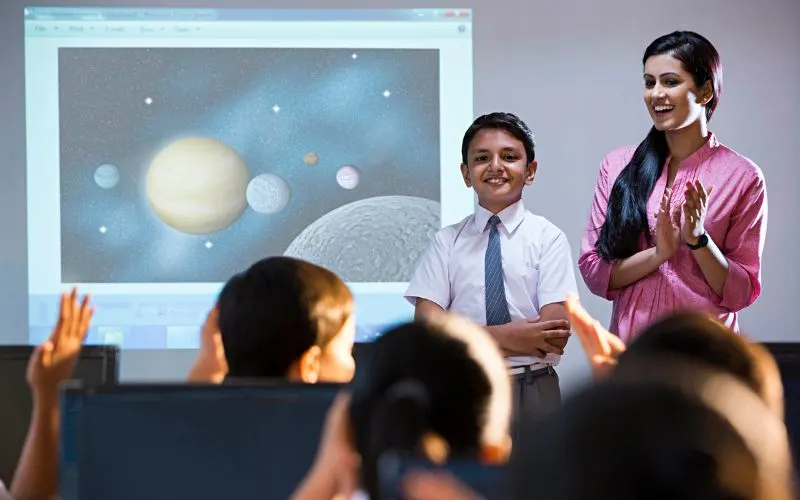
- Smart classrooms equipped with projectors and interactive screens.
- E-learning platforms from which students can learn anytime.
- Virtual labs to conduct science experiments online.
- AI-based tools that allow teachers to monitor a child’s progress.
Imagine your child learning about the solar system not only from the image in the book but also through the 3D motion model on the screen. All such experiences make learning irreversible.
2. Skill-Based Education
The world is rapidly changing. Future employment will require more skills than bookish knowledge. CBSE is now integrating 21st-century skills such as:
- Critical thinking
- Problem-solving
- Communication skills
- Teamwork
- Creativity
Kids develop these skills by working on projects, group assignments, and activity lessons. It prepares them not only for the exams but for life as well.
3. Emphasis on Holistic Development
Education isn’t merely about grades. A bright future is based on emotional, physical, and social development as well. The future of CBSE education will provide greater emphasis on:
- Yoga, meditation, and mindfulness for emotional equilibrium.
- Sports and physical exercises for endurance and strength.
- Arts, music, and drama for creativity.
- Value-based education for developing kindness and respect.
When kids develop in all these aspects, they become confident and happy individuals.
4. NEP 2020 (National Education Policy) integration
The new National Education Policy (NEP) 2020 is a watershed moment for the Indian education system. CBSE is making efforts to embrace its vision. Some of the key changes are:
- Flexible learning rather than fixed streams like Science, Commerce, and Arts.
- Early childhood education and care for solid roots.
- Mother tongue-based education in early years for improved comprehension.
- Hands-on learning where students learn through actions.
- Skill courses such as coding, design thinking, and entrepreneurship.
What this implies is that children will no longer be bound to a single career path. They can pursue what they love and still become successful.
5. Personalised Learning for Every Child
Each child is different. Some are quick learners. Others are slow. Some enjoy maths. Others enjoy art. The future of CBSE education will see individualised learning where:
- Teachers utilise AI tools to determine areas of strength and weakness.
- Lessons are tailored to suit each child’s speed.
- Additional help is available for weak children.
- Challenging activities motivate gifted learners.
This way, no child is left behind, and no child is bored.
6. Global Exposure
CBSE schools are connecting children to the world. Global exchange programmes, global classrooms online, and collaborative projects are the norm.
A child in India might one day collaborate on a project with a child in Japan or Canada. This enhances cultural understanding, communication, and global self-confidence.
7. Environmental Education
Climate change has become such a huge issue. That is why top-rated CBSE schools in Howrah are concentrating on sustainability. Students learn about:
- Conserving water and energy.
- Planting trees and conserving nature.
- Recycling and waste minimisation.
- Using environmentally friendly practices in everyday life.
Tomorrow’s leaders need to be Earth protectors, too. That process starts in CBSE schools.
8. Reforms in Assessment
Examinations tend to cause anxiety in children as well as parents. CBSE is introducing reforms in assessment that check understanding, rather than mere memory. Future exams will emphasise:
- Application-based questions.
- Practical skills.
- Ongoing evaluation throughout the year.
- Open-book and competency-based tests.
This relieves pressure and enables children to learn without fear.
Why Credmont International for Your Child’s Future in CBSE Education?
The future of CBSE education is promising, but it also requires schools that are able to make these innovations real. At Credmont International School, we strongly believe that every child should have the best possible beginning in life.
Here’s why parents trust us for their child’s future
- Modern Learning Environment: We employ technology, smart classes, and activity-based lessons to make learning interesting.
- Caring Teachers: Our teachers are not only educators but mentors who treat each child with love and patience.
- All-Round Growth: We emphasise academics, sports, arts, and values so that children develop in all aspects of life.
- Safe and Nurturing Campus: The safety and happiness of children are our utmost concern. Parents are at peace knowing that their child is being taken care of.
- Future-Ready Curriculum: We incorporate the latest CBSE innovations and NEP 2020 so that tomorrow’s children are well prepared.
We not only prepare children to sit for exams. We prepare them for life.
Conclusion
The future of CBSE schooling is promising and full of hope. With technology, skill-based education, all-around development, and NEP 2020 reforms, kids will be prepared like never before. As parents, selecting the school is one of the greatest choices you will ever make.
Are you searching for “international schools near me”? At Credmont International, we walk hand in hand with you to mould your child’s future. Let us, together, give them the wings to fly high.
Admissions are now open. Come to Credmont International and learn how we can mould your child’s tomorrow today.
FAQs
Q1. What is different about CBSE compared to other boards?
CBSE lays emphasis on conceptual learning, balanced development, and national-level readiness. It also revises its approach to meet future requirements.
Q2. What impact will technology have on CBSE education?
Technology will introduce smart classes, e-learning, virtual labs, and AI-based progress monitoring. Learning will be made interactive and simple.
Q3. What is the role of NEP 2020 in CBSE schools?
NEP 2020 encourages flexible learning, skill-based learning, and early childhood care. CBSE is adapting its curriculum according to this policy.
Q4. How does CBSE prepare kids for competitive exams?
The syllabus of CBSE is formulated to align with national exams such as JEE and NEET. It lays a solid foundation in science, mathematics, and reasoning.
Q5. Will the CBSE education make exams less stressful in the future?
Yes. With competency-based testing and ongoing assessment, exams will be less stressful and more child-friendly.
Q6. Why is skill-based learning necessary?
It prepares children for real-world challenges. Skills like problem-solving, teamwork, and communication are what future jobs will require.
Q7. How does CBSE education promote creativity?
CBSE schools support imagination and innovation through art, music, drama, projects, and other creative work.
Q8. Why should parents choose Credmont International?
Credmont International combines modern CBSE methods with a caring environment. We ensure children get academic strength along with life skills, values, and confidence.